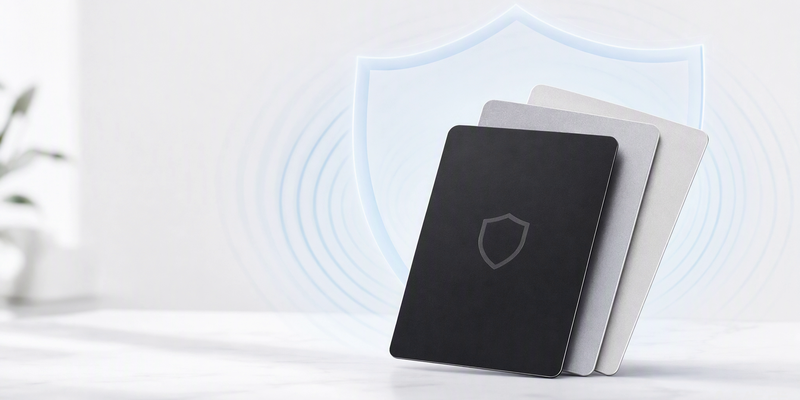
Do RFID Blocking Cards Work? A Complete Guide for Buyers & Brands
Every year, contactless payment makes daily life faster — and wireless theft easier. If your credit or ID card can be read with a tap, a thief with a hidden reader can potentially do the same from up to 10 cm away, without ever touching your wallet. That threat is called RFID skimming, and one of the simplest defenses fits right inside your wallet: the RFID blocking card.
In this guide, we explain how an RFID blocking card works, whether it actually protects your cards, where the real-world risks are, and — for banks, insurers, wallet brands, and distributors — how to source them in bulk from a manufacturer with factories in both China and Thailand.
- What Is RFID Skimming — and Are Your Cards at Risk?
- How Does an RFID Blocking Card Work?
- Do RFID Blocking Cards Really Work?
- High-Risk Scenarios: Where Skimming Happens
- B2B Opportunities: OEM/ODM Custom Blocking Cards
- Why CHIPBOND: Dual-Base Manufacturing & Up to 50% Tax Savings
- Frequently Asked Questions
What Is RFID Skimming — and Are Your Cards at Risk?
RFID (radio-frequency identification) powers the tap-to-pay convenience in millions of contactless smart cards — credit cards, debit cards, transit passes, building access credentials, and e-passports. The card contains a small antenna and chip that responds when a reader sends a radio signal at 13.56 MHz.
The same convenience cuts both ways. A portable reader in the wrong hands can query nearby cards wirelessly: within roughly a 10 cm range, a card in a bag or pocket can be "woken up" and prompted to transmit cardholder data — no physical contact required.
To be clear: modern EMV contactless transactions include dynamic encryption, so skimming losses are rarer than other fraud types. But security-conscious consumers — and the brands serving them — treat passive protection as cheap insurance. That's the market gap the RFID blocking card fills.
How Does an RFID Blocking Card Work?
An RFID blocking card looks and feels exactly like a standard credit card (CR80 size, 85.5 × 54 mm). Inside, however, it carries a specialized circuit — typically a passive jamming antenna — instead of a payment chip.
Here's the principle: when a foreign reader's signal reaches the blocking card, its circuit absorbs that energy and re-emits an interfering signal. This creates electromagnetic "noise" that masks the responses of the genuine cards stacked next to it. To a skimmer's reader, the whole card cluster appears unreadable.
Key advantages over other protection methods:
- Zero learning curve. Slide it into your wallet next to your payment cards. That's the entire setup.
- No battery, no charging, no app. The card is passively powered by the reader's own signal, so it never runs flat.
- No maintenance. There's nothing to update, pair, or replace on a schedule — it works year after year.
- Universal fit. Same footprint as a credit card, so it works in any wallet, cardholder, or passport sleeve.
Most blocking cards shield the two cards on either side, which matches how most people store cards in a wallet — one or two blockers usually cover a full stack.
Do RFID Blocking Cards Really Work?
It's a fair question — and the honest answer is: yes, for the threat they're designed against, provided the card is well engineered.
Independent tests consistently show that a quality blocking card prevents an off-the-shelf reader from extracting data from adjacent cards. What a blocking card does not do:
- It doesn't stop online fraud, phishing, or physically stolen cards — only wireless scanning.
- It doesn't block cards stored several slots away; protection is proximity-based.
- It can't compensate for a weak circuit. Cheap clones with poor antennas deliver weak shielding.
This is where manufacturing quality matters. A blocking card is essentially a precision RF product: antenna design, layer alignment, and lamination quality determine how much of the 13.56 MHz band gets jammed. Sourcing from an experienced RFID manufacturer — rather than a general promotional-goods supplier — is the difference between a blocker that works and one that's just a piece of plastic.
If you're evaluating protection for your own wallet, you can explore CHIPBOND's RFID blocking card — engineered and produced by a factory that has manufactured RFID cards since 1996.
High-Risk Scenarios: Where Skimming Happens
RFID skimming favors crowds, queues, and cramped spaces where a 10 cm read range goes unnoticed:
- Metro and commuter trains. Packed cars and turnstile queues put your wallet within centimeters of strangers — ideal cover for a hidden reader.
- Airports. Security lines and boarding queues concentrate thousands of contactless credit cards and e-passports in one place.
- Shopping malls and events. Elevators, checkout lines, concerts, and stadiums offer the proximity thieves need, plus signal noise to blend into.
- Cafes and coworking spaces. Bags slung over chair backs put cards at ideal read height for someone seated behind you.
None of these scenarios require panic — they require passive protection. That's the consumer story that makes RFID blocking cards an easy product for brands to offer.
B2B Opportunities: OEM/ODM Custom Blocking Cards
RFID blocking cards have become one of the most popular functional gift and bundling products in the security-adjacent promotional market. Typical buyers:
- Banks and fintechs — bundled with contactless card launches to reinforce a security-first brand message.
- Insurance companies — high-perceived-value client gifts tied to "protection" messaging.
- Corporate gifting programs — a practical giveaway with full-color logo printing that recipients actually keep in their wallet.
- Wallet and accessory brands — bundled with leather goods and RFID-safe wallet lines.
- Distributors and promotional suppliers — a fast-moving SKU with strong margins and repeat orders.
As a manufacturer, CHIPBOND offers full OEM/ODM support: custom artwork, logo printing, packaging, and technical tuning of the shielding circuit. Whether you need 5,000 branded cards for a campaign or a long-term retail supply program, we produce to your specification — with the same quality control applied to our RFID cards and smart card lines.
Why CHIPBOND: Dual-Base Manufacturing & Up to 50% Tax Savings
Choosing where your blocking cards are made now matters as much as how they're made. CHIPBOND operates manufacturing facilities in both China and Thailand — a genuine China+1 advantage:
- Tariff flexibility. Choose the production origin that best fits your tariff environment. Orders produced at our Thailand facility qualify for up to 50% tax/duty reduction, directly lowering your landed cost.
- Reliable delivery. The two production bases back each other up, so capacity disruptions at one site don't break your launch schedule — both plants support high-volume wholesale orders with stable lead times.
- Deep RFID expertise. Our Dongguan factory has manufactured RFID products since 1996, backed by a chip distribution background that secures genuine, traceable components.
In short: factory-direct pricing, dual-origin options, and nearly three decades of RFID engineering — behind a product your customers will carry every day.
Frequently Asked Questions
Q1: Do RFID blocking cards really work?
Yes — a well-engineered RFID blocking card reliably prevents an off-the-shelf reader from extracting data from the cards beside it. Independent tests consistently confirm the jamming effect within the card's shielding radius. Quality varies by manufacturer, though, so source from an experienced RFID producer rather than a generic promotional supplier.
Q2: How does an RFID blocking card work?
It uses a passive jamming circuit: when a foreign reader's signal hits the card, the circuit absorbs that energy and re-emits interference that masks your real cards' responses. It needs no battery or charging because it's powered by the reader's own signal, and it stays effective for years.
Q3: How do I use an RFID blocking card?
Simply slide it into your wallet between or beside your payment cards — no setup, app, or activation needed. Most blockers shield the one or two cards on each side of them, so position it in the middle of your most important cards for full coverage.
Q4: What is the best RFID blocking card?
The best RFID blocking card is one with a properly engineered antenna circuit, dual-band shielding (13.56 MHz and 125 kHz), CR80 credit-card dimensions, and factory-verified test data. Printing quality matters too if the card carries your brand — CHIPBOND's RFID blocking card meets all of these as a manufacturer-direct product.
Q5: How long do RFID blocking cards last?
A quality blocking card typically lasts for years of daily use, since its passive circuit has no battery to drain and no moving parts to wear out. It keeps working as long as the embedded antenna stays intact, which is why durable lamination matters. If a card is cracked or heavily bent, replace it.
Q6: Are RFID blocking cards safe for my credit cards?
Yes, they're completely passive and cause no damage. The blocking card only activates when a reader's signal reaches it, and it doesn't alter, erase, or interfere with your payment cards' chips — it only masks them from unauthorized scanning. Your cards tap and pay exactly as before.
Get a Quote for Custom RFID Blocking Cards
Whether you're a bank launching a contactless card campaign, a wallet brand building a bundle, or a distributor scouting your next SKU, we'd love to help.
💬 Leave a comment below with your target quantity and customization needs, or
📧 Email us directly at info@chipbond.com — our team replies within one business day with pricing, artwork templates, and lead times.
CHIPBOND — RFID blocking cards manufactured in China and Thailand, ready for your brand.